When Will the Tv Show Empire Air Again
Every bit the battle of wills and might betwixt Russia and the w over the fate of Ukraine unfolds, there is one key fact to bear in heed: Vladimir Putin has never lost a state of war. During past conflicts in Chechnya, Georgia, Syria and Crimea over his 2 decades in ability, Putin succeeded by giving his military machine articulate, achievable military objectives that would let him to declare victory, credibly, in the eyes of the Russian people and a wary, watching earth. His latest initiative in Ukraine is unlikely to be any dissimilar.
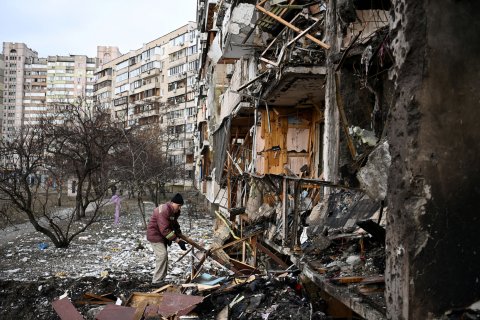
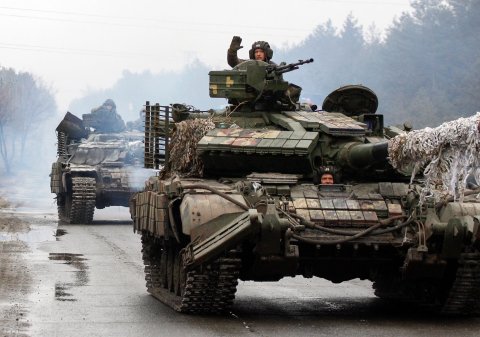
Despite months of military build-upwards along Ukraine'south borders and repeated warnings from the Biden administration that an incursion could happen at any time, the February 24 pre-dawn bombing campaign that kicked off Europe's first land war in decades seemed to come up as a surprise to many Ukrainians. In major cities across a country the size of the state of Texas, stunned citizens, lulled into complacency by their president's repeated reassurances that Russian federation would non invade, watched and listened to the sound of thunderous explosions targeting Ukrainian armed forces bases, airports and command and control centers. Within 24 hours, the disharmonize spread rapidly, with Russian tanks and troops moving swiftly toward Kyiv, the uppercase; fierce battles in Kharkiv, the second largest city; and fighting around Chernobyl, the site of the disastrous 1986 nuclear reactor meltdown. Daze and awe, Russian style.
In an instant, Russian President Putin's invasion of Ukraine destroyed the post Cold State of war security club in Europe—one centered, to Russia'due south fury, past an often-expanding NATO brotherhood. Analysts await that, once Kyiv falls, the military assailment will requite way to a political settlement that puts a Russia-friendly government in place. Past Feb 25, Ukrainian President Volodymyr Zelensky was because an invitation from Moscow to hold "neutrality" talks in neighboring Belarus. If those talks happen, Putin will then exist able to pull back troops and end the disharmonize—while having dealt the Westward a humiliating blow.
And that, war machine and Russia experts agree, may be the real point.
Ukraine, of grade, is non a NATO member; the possibility that information technology might bring together the Alliance some day, as other countries that were in one case part of the old Soviet bloc have done, is a fundamental issue in the current conflict. Putin's actions, a brazen defiance in the face of repeated warnings and threats of sanctions from U.Southward. President Joe Biden and western allies, at present get in a certainty, if information technology wasn't before, that membership will never happen. Putin's aggression will also serve as a stark warning to countries formerly part of the Soviet Matrimony of the possible repercussions of getting also cozy with the West.
The mail Soviet condition quo in Eastern Europe was one "that [Putin] never accustomed," says Fyodor Lukyanov, editor in chief of Russia in Global Affairs, a Moscow-based foreign policy periodical. "It ate at him. He believes Russia was treated [by the West] as a second class citizen after the Soviet Union fell."
Now, western diplomats and intelligence officials believe, Putin seeks to decapitate the western-leaning leadership in Kyiv headed past Zelensky and replace it with a government that will exist loyal to "the new Tsar," equally former Estonian President Toomas Ilves calls Putin. That could happen, U.South. intelligence officials tell Newsweek, inside days. Putin does not desire, nor does he need, to occupy the entire country to attain his greater goals, intelligence analysts and officials say. As Ilves puts it, "He wants a boob state like Belarus," another former Soviet province just north of Ukraine, and from which troops poured into Ukraine as the Russian bombing ramped upward. With a new reality on the ground in Eastern Europe, Ilves continues, "Putin then wants to rewrite the security rules of the road between him and NATO."
Ukraine itself appears to share at to the lowest degree part of that view. A statement from Mykhailo Podolyak, an adviser to Ukraine's presidential chief of staff, and shared with Newsweek by Ukraine'due south diplomatic mission in Washington, outlined what Kyiv suspected were Moscow's goals. "The Function of the President of Ukraine believes the Russia has two tactical goals—to seize territories and attack the legitimate political leadership of Ukraine in order to spread chaos and [to] install a marionette authorities that would sign a peace bargain on bilateral relations with Russia," Podolyak said.
A United States that idea it was pivoting to Asia, and focusing on Communist china—a state that is its preeminent rival going forward—has at present been dragged dorsum to Eastern Europe, where for centuries so much blood has been spilled. Putin now has the globe'south total, undivided attending, in the aforementioned way that every Secretary General in the Soviet era did. In spooky televised remarks afterward the invasion had begun, Putin said, "whoever tries to interfere [in Ukraine] should know that Russia's response will be immediate, and volition lead to such consequences that y'all accept never experienced in your history." Putin'southward subsequent proclamation that he was putting Russia'southward nuclear forces on alerts, underscored the threat.
Russian federation is now back in the limelight, a nation that is demonstrating, with a brandish of military might, that it remains a Neat Power. Which is precisely where Putin wants his nation to exist. He believes Russian federation should at all times command respect from the residual of the world, "and when it doesn't command respect, information technology should command fright," as Lukyanov of Russian federation in Global Affairs puts it.
Mission accomplished. Equally Rose Gottemoeller, former deputy secretary full general of NATO and a long time Russia watcher characterized it recently on the CBS podcast Intelligence Matters, "This is [Putin'southward] 'look at me' moment."
The Westward Responds
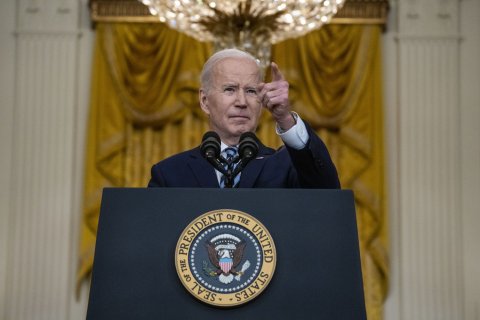
Within hours of the invasion, the United States and its allies responded by sharply ratcheting upward economical sanctions but it's unclear whether the moves will deter the Russian leader. In a speech announcing the response, Biden said more than half of the West's loftier tech exports to Russia would exist slashed, "degrading their industrial chapters," and hurting industries similar aerospace and shipbuilding. He'south as well freezing the U.South. assets of four additional Russian banks, including VTB, the country'southward second largest financial establishment, whose CEO is very close to Putin. "This is going to impose severe costs on the Russian economy, both immediately and over time," Biden said.
The following day, the White House announced it would bring together the European Union in implementing sanctions against Putin personally. The Russian President is widely thought to be i of the globe's richest men, allegedly hiding much of his wealth in shell companies in various revenue enhancement havens throughout the globe.
How effective the sanctions will be is unclear. Putin, for his office, believes he has effectively fabricated his country sanctions-proof. Russia has over $630 billion in hard currency reserves, and rakes in $fourteen billion per calendar month in oil and gas exports. Equally Russia's ambassador to Sweden, Viktor Tatarintsev, told Swedish paper Aftonbladet days before the invasion began, when the W ramped up threats of financial penalties in a futile try to preclude war machine action, "Alibi my linguistic communication, only we don't give a shit about your sanctions."
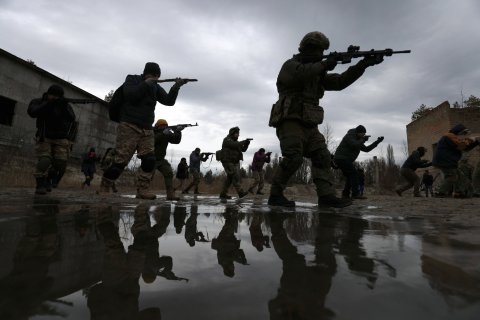
Biden, in his remarks the twenty-four hour period the invasion began, said he believes Putin may accept brought himself a globe of problem by invading Ukraine. "History has shown fourth dimension and again how swift gains in territory give way to grinding occupation, acts of mass civil disobedience and strategic dead ends," he said. And in fact, thousands of Ukrainian civilians accept been training every bit role of newly formed "territorial defense organizations" gear up in club to resist the Russians.
But U.S. intelligence officials privately do non share Biden's optimism about "mass disobedience." I official who spoke to Newsweek on background because he is not authorized to speak on the record said, "After the government in Kyiv is dismantled, there will be no opposition within Ukraine for us to support militarily."
His pessimism is rooted in Putin's past behavior, most notably when he presided over a scorched earth campaign to brutally put downwardly an insurgency in Chechnya more than xx years ago. He says, "Information technology's not realistic to mount an opposition campaign. [Putin] does not value human life the same way that the complimentary world does, hence [Russian troops] will eradicate whatsoever opposition en masse."
Indeed, Putin'southward history every bit a commander in principal of Russia's armed forces shows that in that location may be reason to doubtfulness Biden's optimism that Ukraine volition turn into a quagmire for Moscow. Beyond the ruthless campaign to put down Muslim rebels in Chechnya, he hived off the 2 sections of the sometime Soviet state of Georgia that he wanted to control in 2008. Then in 2022 he took dorsum Crimea in Ukraine, and set up separatist movements in ii heavily Russian provinces in the eastward, Donetsk and Luhansk. (Ii days before the February 24th invasion, Putin declared those ii provinces were now "independent republics." )
And on the circuitous battlefield in Syria, where the U.S. and Russians risked conflict, former President Barack Obama funded opposition rebel groups, including some tied to Al Qaeda, then failed to enforce his ain carmine line after President Basar Al Assad used poisonous substance gas on his enemies. Putin sent Russian troops in with i goal: that Assad maintain his grip on power. He remains in office to this day.
The Ultimate Goal
What is Putin's endgame now? The Russian leader is fueled by rage and seeks revenge confronting the W for his homeland's perceived mistreatment, says Peter Crude, a senior fellow at the Hudson Establish, a bourgeois think tank based in Washington. The country Putin grew upwards in, and the ane he served as a KGB officer, dissolved in 1991. In its stead came chaos at abode, and, in Putin'south view, expose from abroad.
The demise of the Soviet Union, he has famously said, "was the nigh catastrophic geopolitical outcome of the 20th century" (worse, fifty-fifty, than Earth War 2, in which twenty million Soviet citizens were killed). His resentment over what happened to his country, particularly in the immediate backwash of the Soviet collapse, is more than widely shared by Russians than many in the Westward appreciate.
As the Moscow bureau primary for this magazine in the early on 2000s, I saw organized crime take over businesses big and small-scale; the state's finances were in shambles. The government was unable to pay the salaries of a in one case proud armed forces. I interviewed an Regular army colonel stationed on the Kamchatka Peninsula, in Russia'due south far eastward, who wept as he confessed he wasn't able to purchase his wife a birthday present a few weeks earlier because he had not been paid his wages in months.
Boris Yeltsin, once the democratic hero who helped bring down the Soviet Union, had turned into a drunken mess as the first freely elected president of Russia; his inner circumvolve was corrupt, enriching themselves as ordinary citizens struggled amidst the mail Soviet anarchy. On New year's day, at the dawn of the new millennium, Yeltsin stepped down. He was replaced by the man he had named Prime Minister months before, Vladimir Putin.
20-two years later, in an boggling 55-minute speech to his country on Mon Feb 21, Putin aired many of his grievances in a mode he rarely had publicly before, as a prelude to war. In it, he said, "Ukraine is not a separate land," and that "Ukrainians and Russians were brethren, i and the same." Kyiv, in his view, had been ripped unceremoniously from Mother Russia when the Soviet Union dissolved. He then recounted the Westward's early promise non to expand NATO.
He recalled how coldly then President Bill Clinton responded to his query, not long after he became President of Russian federation in 2000, about whether Moscow could e'er be a member of NATO. He recalled, bitterly, how he was assured that NATO'due south expansion due east—to include countries that had been members of the Warsaw Pact, Moscow's old client states—would "only meliorate their relations with us, even create a chugalug of states friendly to Russia.
Everything," Putin said, "turned out exactly the opposite. They were just words."
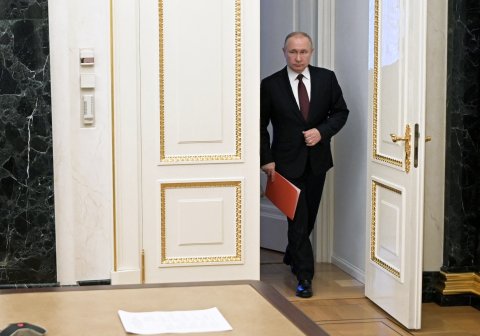
How does Putin seek revenge for this betrayal? To the extent he can, he wants to slice together a new Russian Empire. Not necessarily every province of the erstwhile Soviet Union, only those parts of the pre-Soviet empire, established by the Tsars, who were largely Russian speaking, orthodox Christian and who looked first to Kyiv, and and then later to Moscow, as the political, cultural and spiritual center of the globe.
Putin is a nationalist starting time and foremost. Ukraine, patently, is fundamental to this vision. Simply it also includes the countries—onetime Soviet provinces—that are at present effectively Russian client states (Belarus), every bit well equally those Moscow wishes to command nonetheless over again: the Baltic states of Lithuania, Republic of estonia and Latvia (the latter iii are now members of NATO, for whom the alliance is obligated to fight in the result ane of them is attacked.) Putin in his pre-invasion speech said it was "madness" that the Baltics were ever allowed to leave the USSR. He has demanded—preposterously—that the Brotherhood pull back to its 1997 opinion, when there were just 16 members, as opposed to 30 today.
Point, Counterpoint
It is for that reason that Biden is moving more NATO troops and materiel into the Baltics. On February 25, NATO Secretarial assistant General Jens Stoltenberg said the Alliance would for the first fourth dimension dispatch troops from the Spearhead Unit of its so-called Response Force—formed in 2014—to fellow member states along the eastern front. NATO describes the Response Force equally ''highly fix and technologically advanced." It consists of twoscore,000 troops from a diversity of NATO countries. Stoltenberg declined to say precisely how many troops would be deployed now.
More deployments are likely in the months alee. President Biden vowed in no uncertain terms that an attack on a NATO fellow member would trigger Article 5, the provision that maintains any armed set on against 1 country in the Brotherhood is considered an attack against all. If Putin moves on the Baltics, or on whatever NATO members that formerly were part of the Warsaw Pact—like Poland and Romania, which edge Ukraine, or Bulgaria—then Moscow volition be at war with NATO.
With the invasion of Ukraine, analysts believe, Putin hoped to shake NATO. He wanted, says Douglas Wise, a former CIA officer and deputy director at the Defense Intelligence Agency, "to farther carve up our allies, and cement existing fissures and disunity within [the Alliance] and the EU. He also believes he tin benefit past humiliating the Western leaders and institutions when they fail to develop credible and practical options to counter his aggression."
Whether Putin benefits at home for his audacious attack on Ukraine is not yet clear. (There were small protests in major Russian cities in the immediate aftermath of the invasion.) But if creating more stress on NATO was one of his goals, that failed.
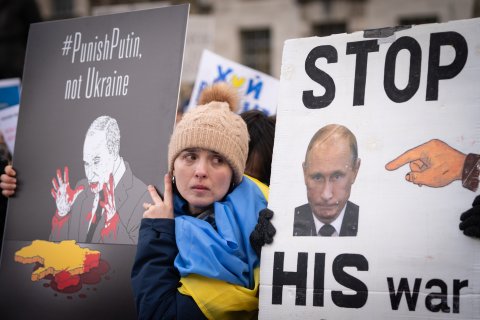
The Germans were widely viewed every bit the weakest link when it came to Russian federation, considering of the ii countries' meaning trade ties. And at the outset of the crisis, that skepticism seemed justified. Early on, for instance, Estonia wanted to send a batch of old howitizers in its possession to Kyiv. But NATO regulations say that whatsoever weaponry given or sold to a non-NATO member must be canonical past the country of origin. In this example, that state did non exist: The howitzers had been in possession of the old E Germany. Upon unification, Germany took control of them and ultimately passed them on to Finland, who eventually gave them to Estonia. When Tallinn wanted to transport them on to Ukraine, to exercise its flake to assistance shore up Kyiv'south defenses, Federal republic of germany—astonishingly—declined to approve the transfer.
That was followed by Berlin'due south deep reluctance to stop the Nord Stream 2 natural gas pipeline linking Federal republic of germany and Russia, despite pressure to do so from its own ambassador to the U.S., Emily Haber. Following the refusal, Haber wrote a widely publicized cablevision to new Chancellor Olaf Scholz, saying that the country was gaining a reputation as a bad marry.
To Putin, this must take indicated that his gas-politik was paying huge dividends. Merely it didn't terminal long. Scholz visited Washington in early February and, in a post coming together press conference with Biden, stood by meekly as the president asserted that Nord Stream 2 was expressionless if Moscow took armed forces action against Ukraine. On cue, hours later the invasion began last calendar month, Germany halted certification of the $11 billion project. Days later, Berlin announced it would ship anti-tank weapons and surface-to-air missiles to Ukraine, a stunning reversal of its long-held refusal to export weapons to conflict zones.
Over the weekend, the E.U. and Washington went even further. They announced that several large Russian banks would exist expelled from SWIFT, effectively boot them out of the international financial arrangement. The allies also sanctioned Russian federation's central banking company. The intent: to get in difficult, if not impossible, for Russia to tap the $630 billion in hard currency reserves it has accumulated. The authority of the move was immediately credible, as the Russian ruble dropped sharply against the U.S. dollar, forcing Moscow to heighten interest rates from 9.v percentage to 20 percent to shore up its currency.
The prove was clear: Far from deepening fissures within the alliance, Putin's Ukraine gambit has had the opposite event. Quondam CIA Director and Army General David Petraeus, upon returning from the Munich Security Conference soon before the invasion, said he had never seen the Alliance so unified since the days when he served at NATO headquarters during the Common cold War.
The axiomatic unity amid the members of what Biden accurately chosen the most powerful military alliance in history, has just made the plight of Ukraine more poignant. As the invasion unfolded, a fellow member of the Ukrainian parliament in Kyiv, Alexey Goncharenko, begged NATO to impose a no-wing zone, to permit his countrymen to accept a fairer fight on the ground. In that location was naught hazard of that happening, because Kyiv wasn't in the society.
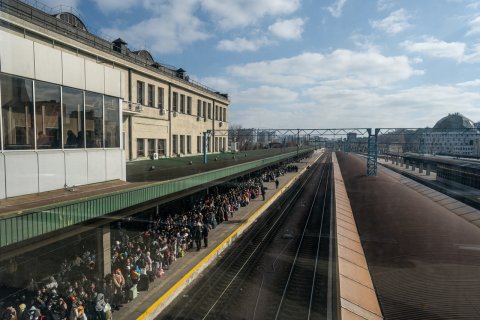
Shortly now, its desire to be role of the West will exist moot, every bit Putin'due south Russia takes command—footling more than 24 hours after the invasion began, Russian forces were already entering the the uppercase and Kyiv was hit with Russian "cruise or ballistic missiles." Success is inevitable considering Biden and the allies have fabricated it articulate that Moscow will not meet armed services resistance from the Due west. Over and over Biden has told the American people the U.S. volition not fight on the footing in Ukraine. He knows the public has no stomach for it.
If events play out every bit military analysts now expect, the conflict will stop relatively rapidly with a negotiated settlement that may cede some territory to Russia, the installation of a new Russian federation-friendly regime in Kyiv and a partial withdrawal of troops that allows Putin to avoid the quagmire the West and so badly wants him sucked into. In doing so, Putin will exist able to claim that he dealt a devastating setback to NATO, the main goal of his aggression.
For Putin, the sack of Ukraine will probable mark the endgame in his desire to restore the empire. If information technology doesn't, it will mean at some point the earth's 2 largest nuclear powers will exist in a shooting state of war, with all the hazard that entails. With his words and more importantly his actions, Biden is frantically signaling to Putin: this far, just no further. An broken-hearted globe hopes the Russian leader, satisfied with victory in Ukraine, will get the message.
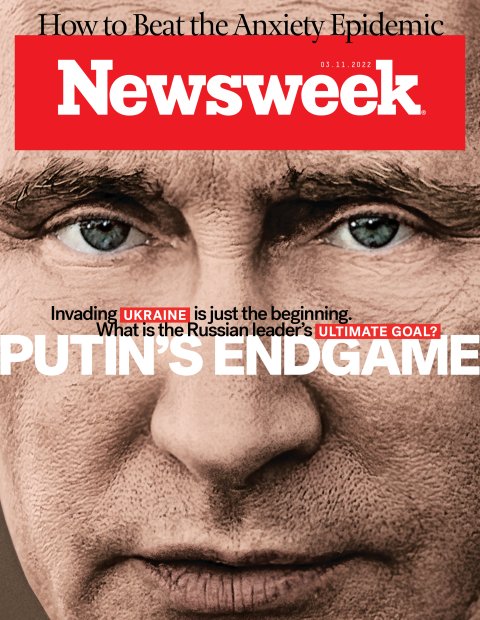
This story was updated on February 28, 2022.
Correction 2/27/22, 10:52 a.m. ET: This story was updated to correct a reference to Bulgaria bordering Ukraine. It does not.
Source: https://www.newsweek.com/2022/03/11/putin-has-never-lost-war-here-how-hell-win-ukraine-1682878.html
0 Response to "When Will the Tv Show Empire Air Again"
Postar um comentário