how to draw 3d air
Drawing 3-D Shapes: 5 Tutorials and Expert Tips & Tricks
If y'all desire to larn to describe realistically, 3-D shapes are a foundation for doing and so. One time you know how to imply multi-dimensional course, you lot tin utilize your knowledge to all types of subjects.
Learn how to draw 3-D shapes and make your art pop off the page.
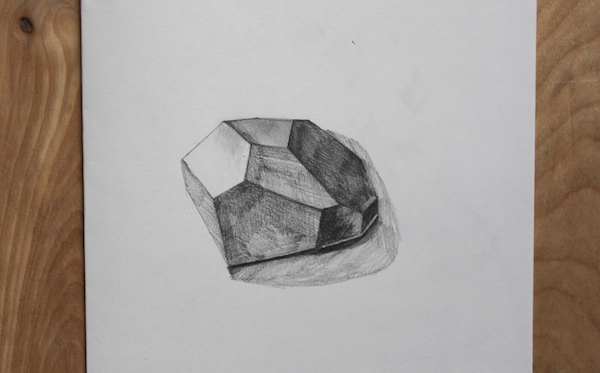
Yous don't demand any special tools to larn this skill. I'm using a pencil and paper, just feel free to utilize pens, colored pencils, crayons — whatever strikes your fancy.
Here are drawing tutorials for five common 3-D shapes with some helpful tips and tricks for drawing them. Each is broken down into simple steps that helps build the overall form.
1. How to draw iii-D triangles
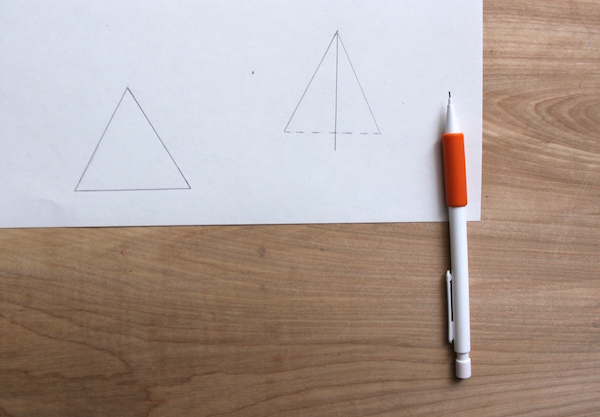
At that place are two types of multi-dimensional triangles: prisms (left) and pyramids (right).
Step 1:
When drawing a prism, showtime with a uncomplicated, flat triangle and modest horizon betoken that's at the side of the shape. It doesn't thing which side you chose. Where you place the horizon signal determines the length and angle of your prism.
To create a pyramid, draw three lines, as shown on the correct above. In the center should be a direct line. From the height of the straight line, draw two angled lines that are the same length. It's OK if the angles aren't exactly identical.
Pace 2:
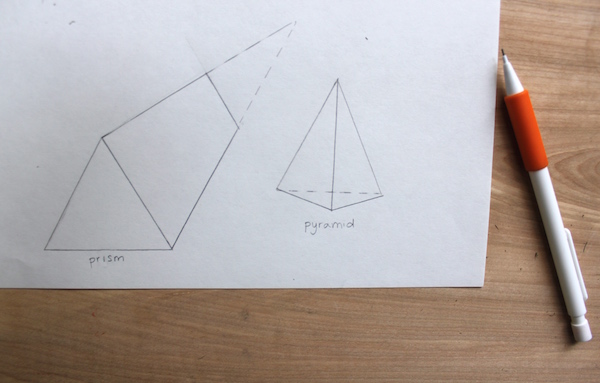
Give your prism a iii-D appearance by drawing two lines: one off the elevation corner and one off the base corner of the triangle that's closer to the horizon betoken. Draw the lines lightly all the way to the horizon betoken. Then, close it off with a unmarried line that's the aforementioned angle as the nearest side of the triangle. Erase the lines extending to the horizon point.
For the pyramid, you'll end the drawing by connecting the three lines at the lesser. Draw a dotted horizontal line to connect the 2 angled lines, and use angled lines to connect each angled line to the centre line.
2. How to draw cubes
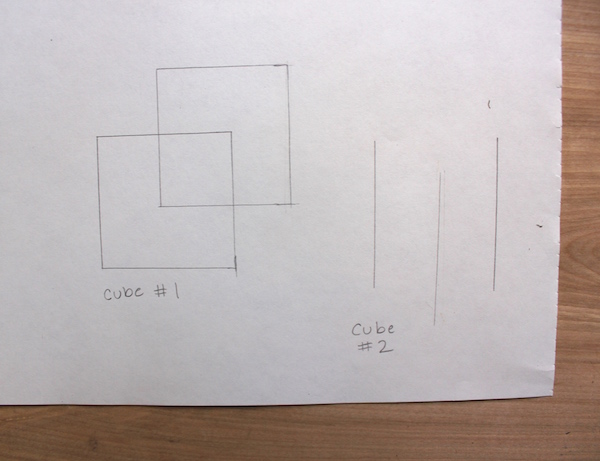
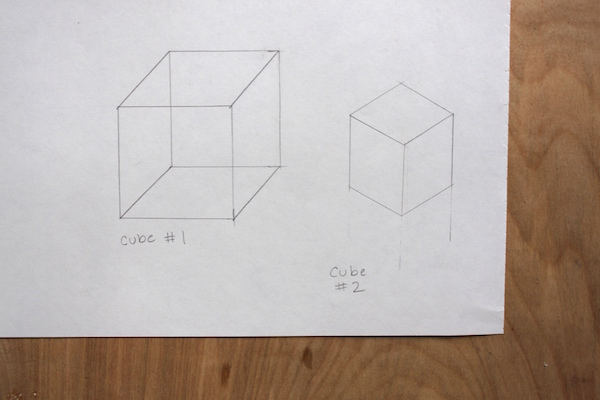
Cubes tin be fatigued in multiple ways, and here, I've created 2.
Pace i:
To start the first cube, draw two squares that are the same size. They need to overlap, just how much is upward to you.
Describe the second cube much like you did the pyramid. This fourth dimension, you'll make iii parallel vertical lines of the same size. The two outer lines should commencement and end at the same betoken, and the eye one should be shifted downwards a bit on the folio.
Step two:
At present information technology's all about connecting corners. On the offset cube, utilise a direct edge to draw angled lines to match the corresponding edges. And then you lot'll connect the bottom right corner of the first square to the bottom right corner of the 2d square. Repeat this will all four corner.
For the second cube, connect the top points of the three lines with angled lines; repeat with the bottom points. Draw a point directly above the center line — the distance betwixt the top of the middle line and the point should be near the length of the eye line. Connect the tops of the outer two lines to the indicate with angled lines.
3. How to draw a cylinder
Step 1:
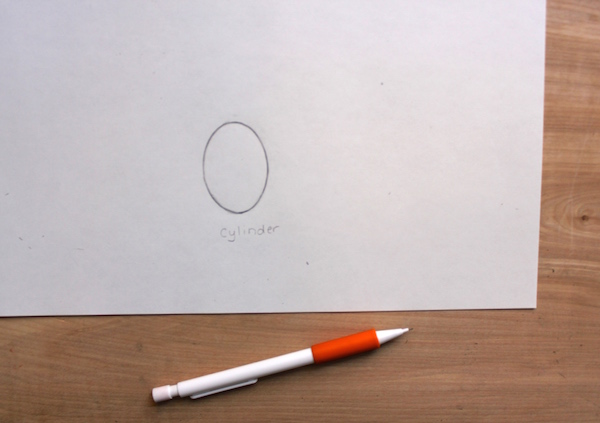
Get-go with an oval. Don't worry if you tin't draw ane perfectly right away — I had to redo mine many times! You could trace something, also.
Pace 2:
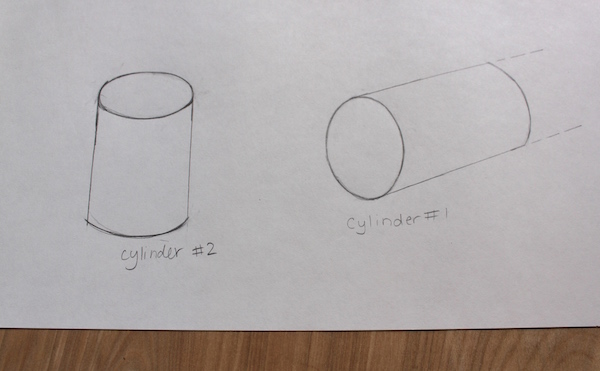
Subsequently yous have the oval down, describe 2 straight, perpendicular lines that come up from either terminate. These lines can exist every bit long as you want and can go in any direction.
Footstep 3:
Connect the straight lines with a curved line that mimics the roundness of the oval.
Tip: To make sure the lesser and top of your cylinder match, attempt turning the paper upside down. Information technology'll change your point of view and any inconsistencies will stand out.
4. How to draw a sphere
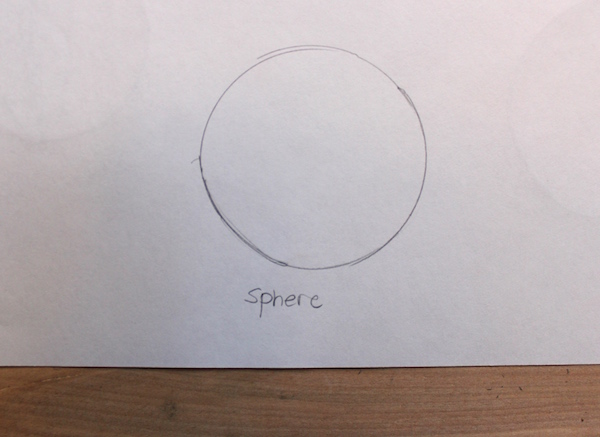
At that place are several means to draw a sphere, ranging from unproblematic to very complex. No matter how much you desire to challenge yourself, a cartoon of a sphere will start with a uncomplicated circumvolve. Draw i freehand or trace a stencil or household detail.
Easier:
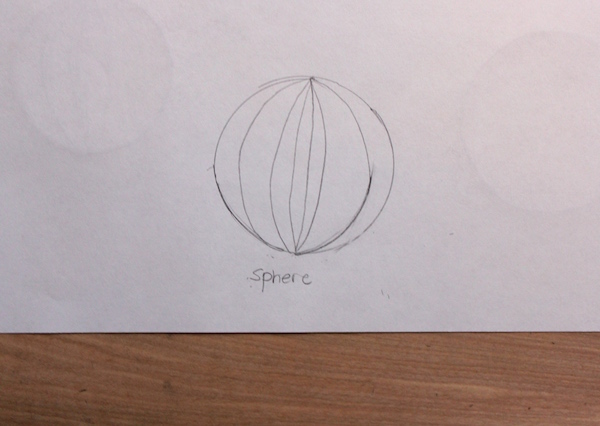
There sphere looks best when it has shading, but yous tin can also brand it appear 3-D by drawing contour lines from summit to bottom. Make sure the bend mimic the curves of the circle, with less exaggeration as you become closer to the middle.
More advanced:
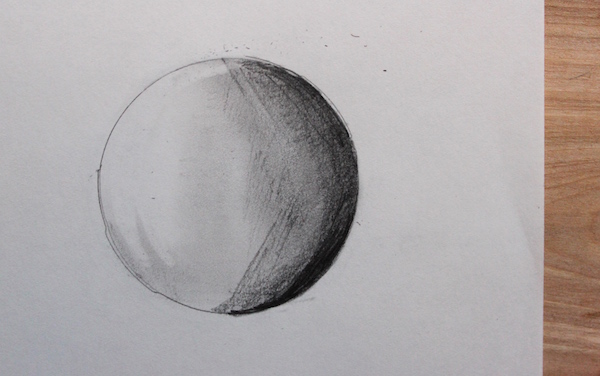
While cartoon a realistic sphere is worthy of its ain tutorial (this ane has peachy step-past-step photos), I exercise want to give yous ane quick and easy way to draw a sphere. This method looks more than lifelike than the example to a higher place, but it's also much faster than drawing a very detailed sphere.
If you want to try elementary shading, try a gradient from light to nighttime across the sphere. In this example, the low-cal is coming from the left, and so the lightest point is on the left of the sphere and the darkest is on the correct. Come across how it looks more than spherical?
5. How to draw a cone
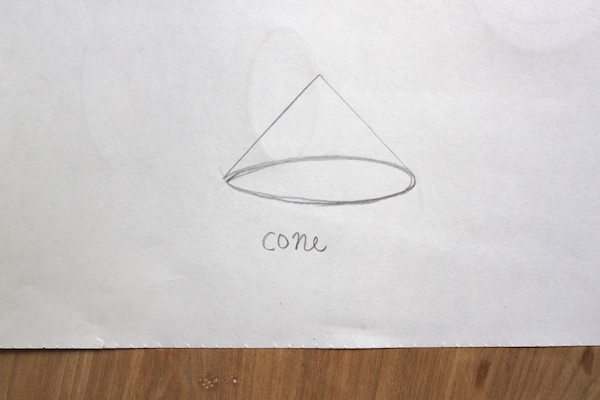
A cone is a cross between a cylinder and a pyramid. And then we'll take what we know from both to draw this three-D shape.
Step one:
Start with a horizontal oval. It doesn't have to be perfect.
Step 2:
To finish, draw the two sides of a triangle. The line for each side should outset at either border of the oval and meet in the eye above the center of the oval.
Tips for drawing 3-D shapes
- When trying to draw something three-D, straight lines are important. Use a straight border (like a ruler) when you lot can. Even if you don't have a ruler, something that's flat and made out of a sturdy material will do.
- Exist aware of the angles of lines. Things similar a cube, for case, require parallel lines to give them their shape. Others, like a cone, can have a variety of angles. Compare angles by property your pencil up to the lines. If they match, then your lines are probably parallel. If you want to get really technical, you can employ a protractor.
- Pencils and erasers are your friend. Whenever possible, draw with pencil to get the angles and lines correct.
Drawing other 3-D shapes
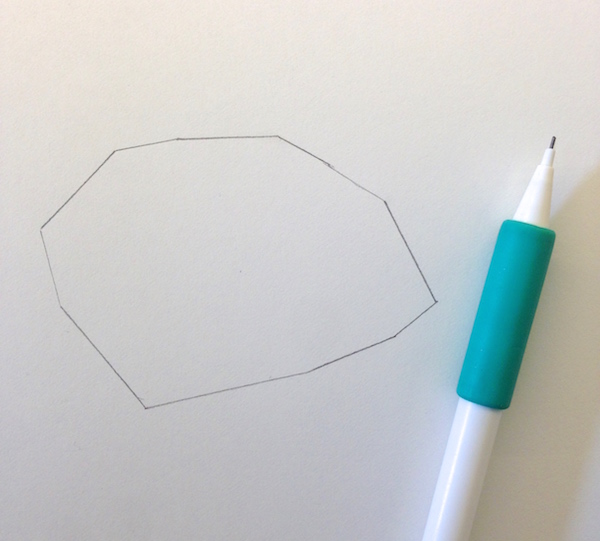
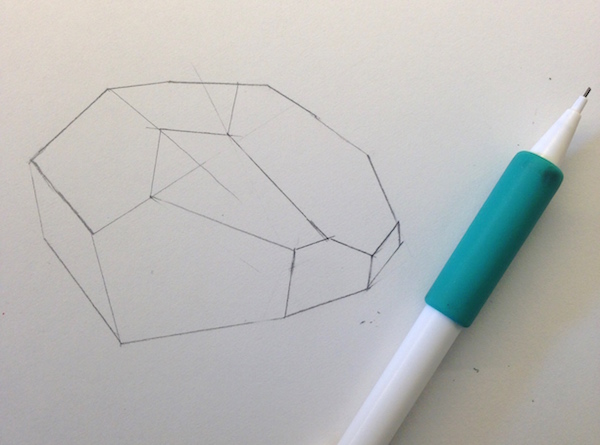
Many objects you depict will fall into 1 of those five major shape categories. If not, remember to cheque your angles and make straight lines. I have this ceramic polygon shape that doesn't really fit every bit a cube, cone or a prism. Here'south how I made it come to life.
Step one:
Past starting with a straight edge, I was able to brand the outline of the shape.
Step two:
I so drew the inside of the shape to convey its multi-dimensional feel. Comparison angles — from the object itself — helped me when drawing. I still had to go back and fix some lines, though.
Footstep 3:
To give the shape even more presence, I shaded parts of it based on the angle of light. This conveys the unlike surface planes and sense of form. Shading is a complex subject area that we don't have fourth dimension to cover in this mail service, but yous can acquire more about it in the Craftsy class 10 Essential Techniques for Better Drawing.
Source: https://www.craftsy.com/post/how-to-draw-3d-shapes/
0 Response to "how to draw 3d air"
Postar um comentário